The 1% that quietly carries the business
Look at the names in your CRM that drive the most revenue. There aren’t many of them. And that’s the uncomfortable part. In regulated online gambling markets, it’s common for 25 to 40% of revenue to come from the top 1% of active players. In some operations, fewer than 5% of users generate more than half of total revenue.
So losing two or three of them in a quarter doesn’t just dent a number. It changes the shape of the entire P&L. That concentration is why VIP management has slowly stopped being a side initiative run by one host with a spreadsheet. It’s turning into a core operational discipline, with its own systems, playbooks, and accountability lines.
And the operators getting it right tend to look very different from the ones still treating their top tier as a generic loyalty program with a fancy name.
What VIP Management Means
There’s a tendency in the industry to use VIP as a label for any player above a certain deposit threshold, hand them a few extra spins, and call it a program. That version of VIP rarely moves retention in any meaningful way.
Real VIP management is a structured operational layer sitting on top of the platform, designed to identify high-value players early, treat them with a level of attention the broader base doesn’t require, and protect the revenue they represent over years rather than weeks. It blends data, human relationships, and service-level commitments that the rest of the platform usually can’t sustain.
The shift in framing matters because it changes who owns it. VIP work touches CRM, customer support, payments, compliance, and responsible gambling teams at once. When those functions aren’t coordinated, even generous programs leak players. When they are, the same budget produces noticeably better retention.
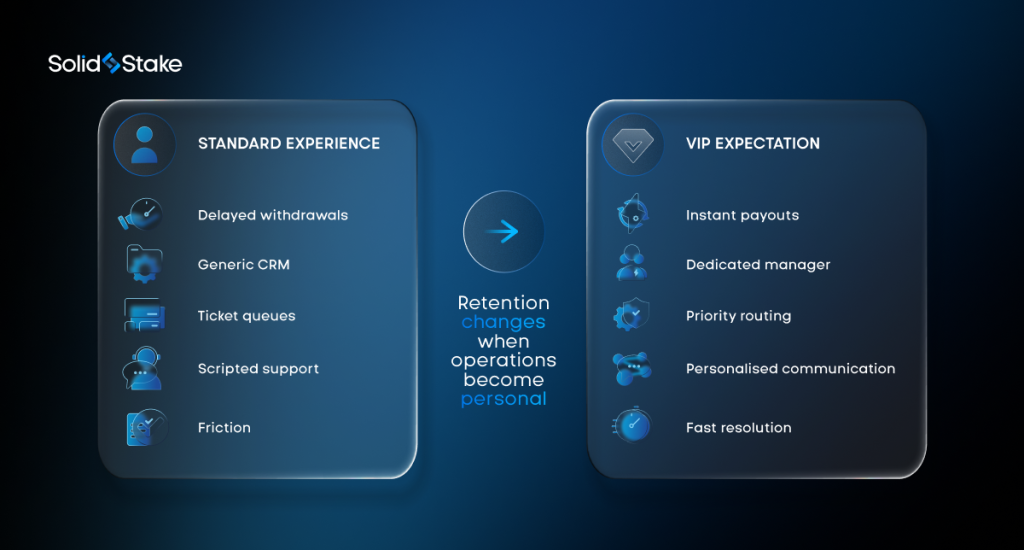
What High-Value Players Expect
The expectations of a player who deposits five and six figures a month are different in scale, but also different in nature. They’ve usually played across multiple operators, they compare experiences quickly, and they have very little patience for friction. A few things consistently sit at the top of their list.
Speed on withdrawals. This is the single fastest way to lose a VIP. Industry data shows 69% of online players say slow withdrawals damage their confidence in a platform, and around half would actively move to a competitor offering faster payouts. For high rollers, where individual withdrawals can be substantial, anything that looks like delay or unnecessary review reads as disrespect. Operators offering instant or near-instant withdrawals see retention improvements of around 30%, and the lift is even more pronounced at the top of the pyramid.
A real human relationship. A dedicated VIP manager who knows the player’s preferred games, time zone, average session, and recent run of luck is not a luxury at this level. It’s the baseline. High-value players want to feel known, and they want issues handled by someone with the authority to actually resolve them, not by a tier-one agent following a script.
Rewards that match how they play. Generic free spins or matched bonuses with high wagering requirements tend to be received with mild irritation. What works is cashback structured around their actual losses, higher limits aligned with their bankroll, exclusive access to tables or tournaments, and occasional gestures (event invitations, personalised gifts) that signal recognition.
Respect for their time. This one is the most underrated. The operational machinery has to be quieter and faster for this segment, even when volumes are peaking everywhere else. In practice that means a few specific things:
- Faster verification when they log in on a new device
- Smooth payment routing with no avoidable friction
- A payments team that can authorise an exception within the hour, not the next business day
Building the Structure: Tiers, Triggers, and Human Touch
A program that performs over the long term usually has three layers working in parallel.
Segmentation that goes beyond deposit thresholds. Two players sitting at the same monthly deposit level often have completely different profiles. One plays high-volatility slots in short bursts, another plays live blackjack across longer windows, and a third might be a sports bettor who moves seasonally. Treating them the same underserves all three. Behavioural segmentation, supported by real-time event tracking inside the CRM, is what makes the rest of the program work. It’s the same shift toward behaviour-led casino analytics that’s reshaping how operators read their wider base.
Automation for the parts that have to be consistent. Instant higher limits when a player crosses a threshold, automatic flagging when their behaviour shifts in either direction, fast routing of their tickets to senior support. This is where CRM tooling earns its place, handling consistency at scale so the VIP manager can focus on the conversations that actually matter.
The human layer. VIP hosts should be running fewer, deeper interactions, not chasing volume. The good ones know when to call, when to send something physical, when to acknowledge a bad run, and when to step back entirely. That judgment is hard to automate, and operators who try to replace it with templated communication usually feel it in their churn numbers within a few months.
Where Most VIP Programs Leak
Even well-funded programs underperform in fairly predictable ways. A few questions to ask yourself:
- Are VIP players getting the same generic CRM messages as everyone else, just with a different banner?
- Do your VIP hosts see payments, support tickets, and responsible gambling flags in one place, or are they working from fragmented systems?
- How long does a VIP withdrawal take to clear on a busy weekend, and how does that compare to a new player’s first payout?
- When a player goes quiet for two weeks, does anything happen automatically, or does it depend on whoever notices?
Most of the friction that pushes high-value players away is operational, not strategic. The strategy is usually fine. The execution drifts because nobody owns the daily detail.
Balancing VIP Value Against Player Protection
VIP management gets harder every year because regulators are watching this segment closely. The UKGC and other regulators have tightened expectations significantly around how operators identify and respond to potential harm in high-spending players. There’s a real tension between maximising the value of a top depositor and intervening when their behaviour suggests they shouldn’t be playing at that level.
The operators handling this well treat affordability checks, behavioural monitoring, and responsible gambling tooling as part of the VIP workflow rather than as a parallel compliance process. The VIP host knows what the RG team is seeing. The conversations happen earlier, more gently, and usually with better outcomes for both the player and the business. Operators who keep these functions in separate silos tend to get caught flat-footed, either by a regulator or by losing a player to a competitor who handled the same situation with more care.
Where to Focus Next
If VIP is currently a function rather than a system inside your operation, a few priorities tend to move the needle most:
- Shift from threshold-based segmentation to behavioural segmentation, and refresh it monthly
- Bring withdrawal speed for top-tier players to a standard you’d be comfortable publishing
- Unify the data your VIP hosts work from, including payments, support, and RG signals
- Reduce the number of players per VIP manager so the relationships can actually be relationships
- Build a clear escalation path for at-risk behaviour that the host owns, not just compliance
The operators getting the most out of analytics tend to share a few habits:
- They prioritize retention metrics over acquisition vanity
- They invest in unified data infrastructure before chasing advanced models
- They apply prediction to clearly defined problems
- They use real-time only where it changes a decision
- They treat compliance as part of the same analytics stack, not a separate silo